Sinai Health is home to Canada’s largest sarcoma program and one of the most respected in the world. It’s a centre where rare, aggressive cancers are met with equally rare expertise, innovation and collaboration.
Each year, Mount Sinai Hospital treats more than 250 patients with bone sarcomas and over 500 with soft tissue sarcomas—the highest volume in the country. This scale—combined with advanced surgical expertise, engineering innovation and translational research—enables a level of care and discovery found at few centres worldwide.
This concentration of experience matters. Sarcomas—cancers that develop in connective tissues such as bone, muscle and nerves—are complex, with more than 100 subtypes. Optimal care requires deep specialization. At Sinai Health’s Chris Hugh Sharp Cancer Centre, that expertise is delivered through a coordinated, multidisciplinary model that connects surgery, medical oncology (cancer treatments using medications such as chemotherapy), radiation oncology, rehabilitation, palliative care and psychosocial support.
“We pride ourselves on a patient-centred, multidisciplinary approach,” says Dr. Geoffrey Watson, a medical oncologist who joined the program in 2021. “Our program is leading in innovation. Patients benefit from a designated referral pathway, advanced nurse practitioners and patient navigators. They also have access to clinical trials, a survivorship clinic and patient support programs.”
Pioneers in precision surgery
The program’s global leadership is anchored by Drs. Jay Wunder and Peter Ferguson, orthopaedic surgeons and co-leads of Mount Sinai’s sarcoma program, alongside an internationally recognized orthopaedic oncology team including Drs. Kim Tsoi and Aaron Gazendam. Their work has positioned Sinai Health as a pioneer in precision surgery.
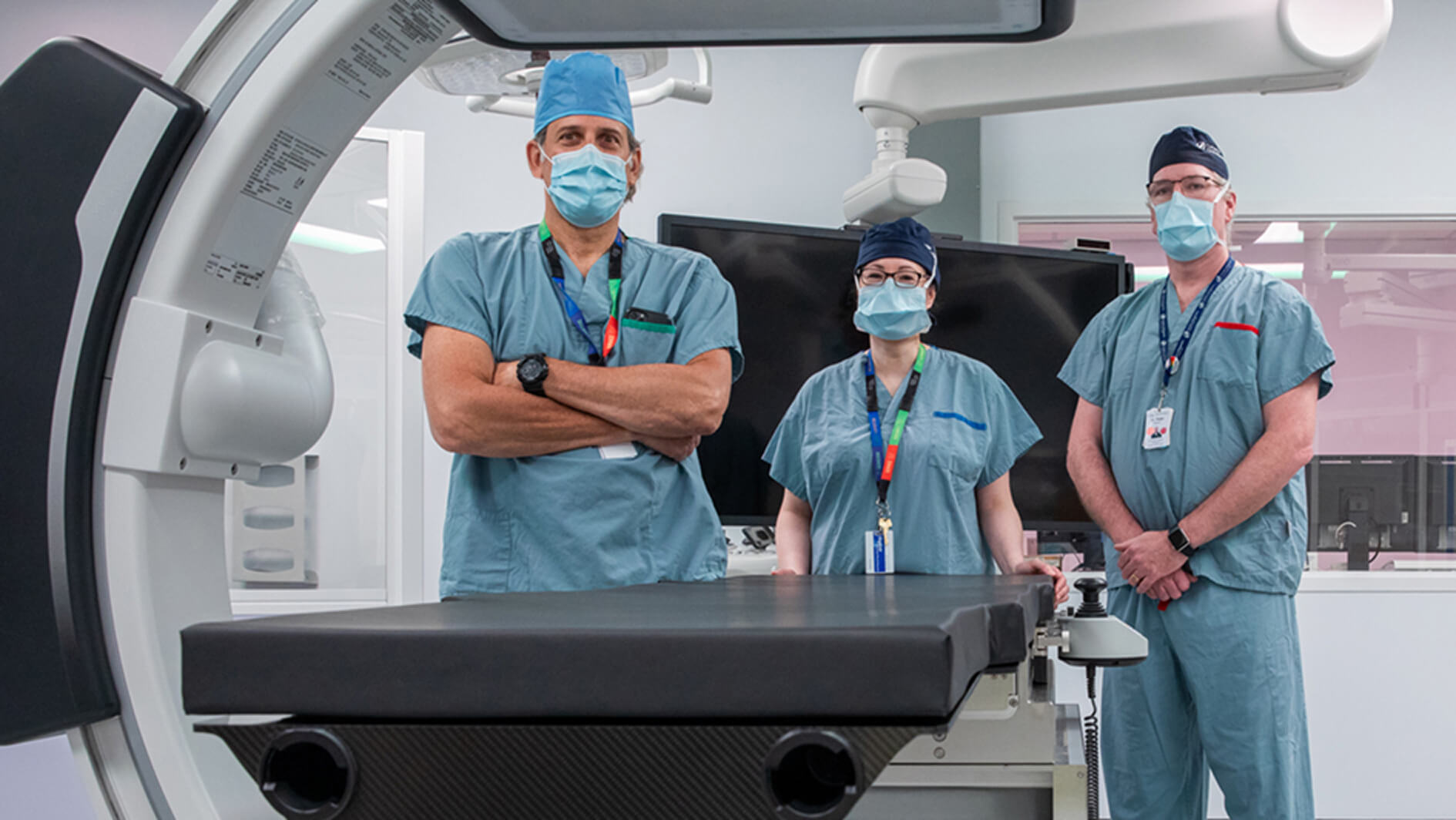
At the heart of this innovation is the donor-funded GTX surgical suite, a state-of-the-art operating room equipped with intraoperative 3D CT imaging and real-time navigation. This “Google Maps for surgeons” allows the team to visualize tumours in three dimensions during surgery, calculate exact cutting planes, and confirm tumour removal in real time—crucial in sarcoma surgery where even a few millimetres can determine whether a cancer returns. The result: more precise tumour removal, clearer margins and better preservation of surrounding healthy tissue to enable improved reconstruction—all of which help patients such as Rob Broberg recover sooner.
Rob, a 56-year-old software developer, was diagnosed with pelvic chondrosarcoma, a rare bone cancer. His 16-cm tumour was deeply embedded in his pelvis, where it was surrounded by critical nerves and blood vessels. Using GTX technology, Dr. Wunder performed a 10-hour surgery, preserving enough bone to maintain the structural stability of Rob’s pelvis. Instead of being on crutches for months or limping for the rest of his life, Rob has already returned to the active life he loves.
“It’s transformative. This technology is important for pushing the boundaries of innovation.”
Sinai Health is also advancing augmented and virtual reality surgical navigation, one of the first programs of its kind for sarcomas. This next-generation technology projects digital maps of the tumour onto the surgical area. Surgeons can adjust plans in real time with hand gestures and use tracking tools to make accurate bone cuts for precise tumour removal and implant placements. Developed by our surgical and engineering teams, it supports both surgical accuracy and training, and is being adapted to help patients better understand their surgical procedures and related issues.
For Connie Lee and Henry Wu, supporting sarcoma care is deeply personal. Needing surgery and shoulder reconstruction to remove a giant cell tumour in his left proximal humerus in 2011, Henry knows first-hand how much patients depend on precision, expertise and trust in their care team. Years later, after connecting with Sinai Health and learning about its leadership in complex sarcoma surgery, Connie and Henry were inspired by the team’s commitment to pushing the boundaries of what’s possible. Their recent $250,000 gift is helping to build upon the GTX surgical suite’s advancements, supporting the kind of innovation that gives patients facing rare cancers greater confidence, better outcomes and renewed hope.
Bridging front-line clinical care and research
Dr. Kim Tsoi, an orthopaedic oncologist with a biomedical engineering PhD in nanotechnology, embodies the intersection of science and surgery. She says that donor support has helped her establish dedicated lab space and build a collaborative translational research program that bridges front-line clinical care and research at the Lunenfeld-Tanenbaum Research Institute (LTRI).
“Where I find the most fulfillment, and where I think the biggest impact will come, is in bridging the excellence of the LTRI with sarcoma research.”
“Our incredible scientists are doing cutting-edge work, but they don’t always know how to apply it to this disease. That’s where I see my role,” Dr. Tsoi says. Sinai Health’s generous donor community has helped advance her work in exploring the immune microenvironment and metastatic behaviour of sarcomas, applying cutting-edge science — from genomic screening to immune pathway research — to a cancer for which new therapies have been slow to emerge.
On the research front, Sinai Health is also advancing new ways to detect and treat sarcomas through biomarker-driven innovation.
The medical oncology team, which sees more than 600 sarcoma patients each year, is developing advanced circulating tumour DNA assays — a form of “liquid biopsy” that detects microscopic tumour DNA in the bloodstream. This emerging technology may help to identify patients at higher risk of recurrence after surgery and guide decisions about additional therapy, ushering in a more personalized, data-driven approach to care.
Sinai Health’s leadership in medical oncology also extends to national collaboration and training. Through initiatives such as the Canadian Sarcoma Research and Clinical Collaboration, Dr. Watson and colleagues are bringing together experts spanning multiple disciplines and provinces – ensuring patients across Canada benefit from shared expertise and evolving global standards.
“We have an obligation to do more”
Sinai Health is also addressing one of oncology’s most overlooked populations: patients with metastatic bone disease. With donor support, a new clinical trial — NAVIGATE-MB, led by orthopaedic oncologist Dr. Aaron Gazendam — is testing less invasive, image-guided surgery for patients with metastatic tumours in the pelvis. Dr. Gazendam is also leading a study investigating the use of wearable device technology, including iPhones, and patient-reported outcome measures to better understand recovery after surgery and improve care among patients with sarcomas and advanced cancers.
Together, these efforts reflect a broader strength: the ability to connect surgical innovation, translational research and clinical expertise to solve complex issues in cancer care.
“Because of our size and our reputation, we have an obligation to do more,” Dr. Tsoi reflects.
At Sinai Health, that means continuing to push boundaries — advancing research, leading innovation, personalizing care and improving outcomes for patients facing some of the most challenging cancers.